


Summary
Private immigrant detention is the scandal hiding in plain sight.
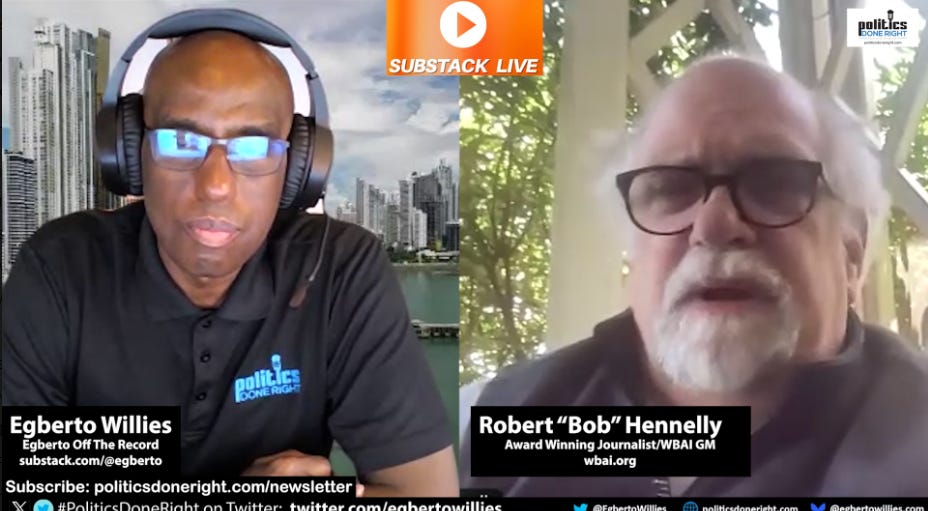
Robert “Bob” Hennelly, an award-winning journalist and WBAI manager, described Delaney Hall in Newark as more than a local controversy. He framed it as a brutal example of Trump-era immigration enforcement, private prison profiteering, federal intimidation, and mainstream media failure. The interview centered on how a for-profit ICE detention facility became a flashpoint after detainees protested alleged inhumane conditions, local officials demanded access, and peaceful community support was reframed as disorder rather than democracy in action.
Hennelly explained that Delaney Hall shifted from a halfway house model into a private ICE detention facility tied to a massive federal contract, while local officials raised serious inspection and accountability concerns.
Newark Mayor Ras Baraka’s arrest outside the facility became a defining moment, especially because he appeared there with members of Congress exercising oversight authority.
The interview emphasized that detainees and their advocates are not abstractions; they are human beings allegedly facing trauma, disorientation, poor conditions, family separation, and exploitation after release.
The conversation condemned the private detention economy as a transfer of public money into corporate profit, with detainees treated as revenue-generating bodies rather than people.
Hennelly argued that the real story is not “riots” but disciplined community resistance, faith-led care, congressional oversight, and the demand that state and local authorities force access, inspections, and accountability.
This interview exposes the moral rot of privatized immigration detention. The issue is not merely one facility in Newark. It is a national system that converts fear, racism, and xenophobia into revenue. A progressive response must reject the corporate cage, defend immigrant humanity, insist on local and congressional oversight, and refuse to let mainstream media reduce organized resistance to a police blotter.
Premium Content (Complimentary)
Robert Hennelly brought the Delaney Hall story into focus with the kind of clarity that corporate media too often avoids. He did not treat the Newark ICE detention facility as an isolated disturbance, a policing challenge, or a fleeting protest story. He treated it as what it is: a collision between federal immigration cruelty, private prison profiteering, local democratic authority, and organized community resistance.
Delaney Hall matters because it reveals the business model behind today’s immigration enforcement. When a private operator receives a massive federal contract to cage human beings, the public must ask who benefits, who suffers, and who gets silenced. Hennelly made the point plainly. People detained inside these facilities become revenue units in a system that monetizes human confinement. The host pushed the point further, identifying the moral horror of public money flowing into private detention companies that profit from the humiliation and confinement of migrants.
That is why the story cannot begin with the word “riot.” It must begin with power. It must begin with a facility that local officials say must answer to health, safety, fire, and municipal standards. It must begin with detainees reportedly raising concerns about conditions. It must begin with families, faith leaders, and peace-and-justice organizers showing up outside the gates to help people who are released with little support, little orientation, and often deep trauma. Hennelly described a community response that did not center violence but care: people helping released detainees reconnect, recover, and navigate the aftermath of confinement.
The public record strengthens that concern. New Jersey has sued GEO Group, the private operator of Delaney Hall, seeking access for health officials to inspect the facility amid allegations of inhumane and unsanitary conditions. The state’s lawsuit followed complaints that inspectors received only limited access and were blocked from key areas, including medical and living quarters. The Guardian also reported allegations of overcrowding, inadequate medical care, contaminated food, beatings, chemical sprays, and forced work for about $1 a day, while noting that DHS and GEO Group deny or dispute many of these accusations.
That denial is predictable. Power always denies until evidence, organizing, and public outrage force acknowledgment. The same pattern appears across too many immigration enforcement stories. First, officials frame migrants as threats. Then they frame protesters as disorderly. Then they frame oversight as interference. Finally, they ask the public to trust the very institutions that operate behind walls, fences, masks, and contracts.
Hennelly correctly insisted that the Delaney Hall story includes history. Newark is not just a location. It is a city with a long memory of policing, race, resistance, and state violence. He connected the arrest of Mayor Ras Baraka to that history and asked why that was not the lead story. A mayor, members of Congress, and community advocates confronted a private detention regime, and the establishment press too often treated the resulting conflict as a security episode rather than a democracy episode.
That distinction matters. A democracy cannot allow federal agencies and private prison corporations to operate as if local government, public health inspectors, clergy, journalists, families, and members of Congress are nuisances. A democracy demands access. It demands public records. It demands medical inspection. It demands fire inspection. It demands that elected officials receive answers. It demands that detainees can communicate with counsel and family. It demands that people held by the state retain their humanity.
The larger context makes the danger even clearer. Recent reporting on a Minnesota ICE-related shooting shows why unchecked enforcement power cannot receive blind deference. Reuters reported that ICE agent Christian Castro was arrested in Texas after Minnesota prosecutors charged him with second-degree assault and falsely reporting a crime tied to the nonfatal shooting of Julio Cesar Sosa-Celis during Operation Metro Surge. Investigators alleged that earlier claims about the incident did not match the evidence. AP likewise reported that federal allegations against the wounded man were later dismissed and that a federal investigation remained ongoing.
That does not mean every agent is guilty of misconduct. It means no agency deserves immunity from scrutiny. It means body armor, badges, and federal contracts cannot replace accountability. It means immigration enforcement, especially under an authoritarian political project, can become a machinery of intimidation unless communities refuse silence.
Hennelly’s most important contribution was his insistence that the movement outside Delaney Hall is not merely protest. It is a public ethic. It is an “Underground Railroad in broad daylight,” as he put it, built around care, solidarity, and restorative justice. That phrase captures the moral center of the moment. The country does not need more cages. It needs more courage. It needs more people willing to stand outside the walls and say that immigrants are not disposable, public money must not finance cruelty, and democracy does not end at the gate of a private detention center.
The progressive position is simple and necessary. Shut down the private detention racket. Let health and safety inspectors in. Let members of Congress do oversight. Protect the right to protest. Defend the humanity of detainees. And stop allowing corporate media to flatten a profound human-rights crisis into a spectacle of “clashes.” Delaney Hall is not just a Newark story. It is a national warning.

[WP-ROUTING]
Site: PoliticsDoneRight.com
Category: Interviews
PubDate: 2026-06-15T23:13:00
Tags: Delaney Hall, ICE detention, private prisons, Robert Hennelly, Bob Hennelly, WBAI, Newark, Ras Baraka, GEO Group, immigrant detention, detainee hunger strike, immigration justice, ICE protests, private prison profits, Trump immigration policy, civil rights, human rights, migrant rights, federal oversight, progressive media, Politics Done Right


